
Small business loans can pay for a new website, a launch campaign or a steady SEO program when cash flow alone cannot. But not every loan allows marketing as a use, and borrowing only makes sense when the marketing is likely to earn back more than the loan costs. This guide compares the main options, explains what each one can fund and shows a simple payback check before you apply.
Key takeaways
- SBA 7(a) loans and SBA microloans can fund working capital, which can include marketing; SBA 504 loans cannot.
- Lines of credit and business credit cards suit short, repeatable marketing costs; term loans suit one-off projects like a website.
- Borrow for marketing only when your numbers show the spend can pay back the loan, interest and fees.
This article is general information, not financial, legal or tax advice. Loan terms, rates and eligibility change and depend on your lender and your business. Speak to your lender, accountant or a qualified advisor before you borrow.
Can you use small business loans for marketing?
Yes, with the right product. Lenders usually group marketing under working capital: the money you spend to run and grow the business day to day. Many term loans, lines of credit and SBA 7(a) loans allow working capital. Loans tied to an asset, such as equipment finance, real estate loans and SBA 504 loans, do not.
Marketing is a weaker form of collateral than a building or a machine, so lenders look harder at your cash flow, credit history and time in business. A clear plan that shows what you will spend, on what, and how you will measure results makes the application stronger.
Small business loans compared
| Option | Typical size | Can it fund marketing? | Best for |
|---|---|---|---|
| SBA 7(a) loan | Up to $5 million | Yes, as working capital | Larger growth plans with a long repayment period |
| SBA microloan | Up to $50,000 (average about $13,000) | Yes, as working capital | New and very small businesses |
| SBA 504 loan | Up to $5.5 million | No (buildings, land and long-life equipment only) | Property and major equipment |
| Bank term loan | Varies by lender | Usually, if the lender allows working capital | A one-off project, such as a new website |
| Business line of credit | Varies by lender | Yes | Seasonal campaigns and ongoing ad spend |
| Business credit card | Varies by issuer | Yes | Small monthly costs paid off in full |
| Merchant cash advance | Based on card sales | Yes, but usually very expensive | A last resort; compare the total cost first |
Figures for SBA programs are from the U.S. Small Business Administration. Bank and card terms vary, so compare written offers.
SBA 7(a) loans
The SBA 7(a) program is the SBA’s main loan, with a maximum of $5 million. Allowed uses include short- and long-term working capital, so a marketing budget can be part of a wider growth plan. Working capital loans are generally repaid over ten years or less. For variable-rate 7(a) loans, the SBA caps the rate at the base rate plus 3% to 6.5%, depending on loan size: the smaller the loan, the higher the allowed spread.
SBA microloans
Microloans go up to $50,000 through nonprofit intermediary lenders. The SBA puts the average at about $13,000, with a maximum term of seven years and rates generally between 8% and 13%. They can cover working capital, inventory and equipment, but not existing debt or real estate. For a new business that needs a website and a first campaign, a microloan is often the most realistic SBA option.
SBA 504 loans
504 loans offer long-term, fixed-rate finance for buildings, land and equipment with a useful life of at least ten years. They cannot be used for working capital or inventory, so they are not a route to fund marketing.
Lines of credit and business credit cards
A line of credit lets you draw money when you need it and pay interest only on what you use. It fits marketing that moves with the seasons, such as a spring campaign for a landscaper or holiday ads for a retailer.
A business credit card is convenient for software, small ad budgets and tools you pay monthly. It works best when you clear the balance each month. Carrying a balance on a card is one of the most expensive ways to fund marketing.
How hard is it to get approved?
Approval depends heavily on the lender. In the Federal Reserve’s Small Business Credit Survey of 7,653 employer firms, applicants were most likely to be fully approved at small banks and least likely at online lenders.
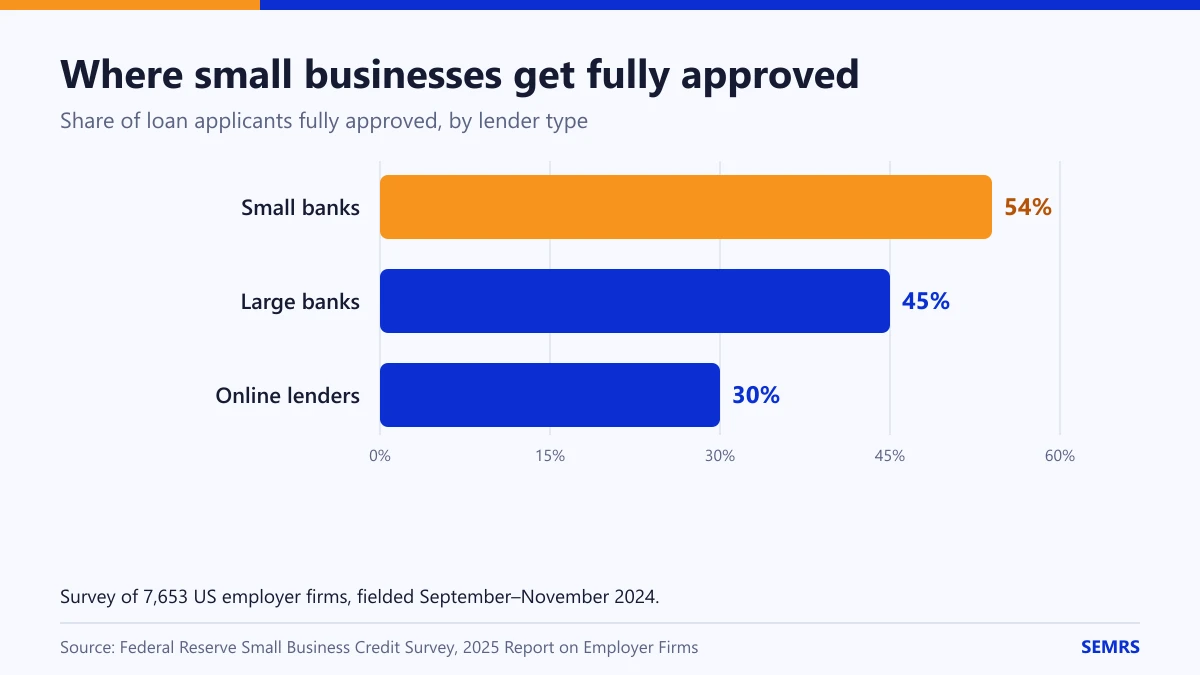
If a large bank says no, a local or community bank, a credit union or an SBA microlender may still say yes. The SBA’s free Lender Match tool can connect you with lenders that offer SBA loans.
Will the marketing pay back the loan? A simple check
Before you apply, work out whether the spend can repay itself. Use your own numbers; the figures below are an example, not a forecast.
- Monthly marketing spend: $1,500 for SEO and Google Ads.
- Expected new customers: 4 a month, based on your current cost per lead and close rate.
- Profit per customer: $600 after delivery costs.
- Monthly profit from marketing: 4 × $600 = $2,400.
- Monthly loan payment: say $500.
In this example the marketing earns $2,400 against $2,000 of spend and repayment, so it covers itself. If your numbers come out below the line, fix the funnel before you borrow: improve the website, track leads properly or start with a smaller test.
Most channels take time. Paid ads can bring leads within weeks, while SEO usually builds over months. Match the loan to that timing: a short-term product for a quick campaign, a longer term for a program that compounds. Our guides to Google Ads costs and SEO costs help you set realistic budgets.
How to apply for small business loans: six steps
- Write a one-page marketing plan. List the channels, monthly budget, expected leads and how you will measure them.
- Check your credit and paperwork. Lenders usually ask for tax returns, bank statements, financial statements and a business plan.
- Decide on the product. Match a term loan, line of credit or card to how you will spend.
- Compare at least three offers. Compare the annual percentage rate (APR) or total cost, fees, term and any prepayment penalty.
- Read the terms. Check personal guarantees, collateral and what happens if you pay late.
- Track results from day one. Use call tracking and analytics so you can see which spend brings customers.
Mistakes to avoid
- Borrowing before you know your cost per lead and customer value.
- Using a merchant cash advance or a high-interest card for a long-term program.
- Spending the whole loan on one untested channel.
- Paying for marketing that cannot be measured.
- Ignoring the repayment start date when you plan cash flow.
Frequently asked questions
Can I get an SBA loan for marketing?
SBA 7(a) loans and SBA microloans can fund working capital, which can include marketing as part of a growth plan. SBA 504 loans cannot, because they are limited to buildings, land and long-life equipment.
What is the easiest small business loan to get?
There is no single easiest loan. Business credit cards and online loans often have simpler applications but can cost more. SBA microlenders and community banks often work with newer businesses. Compare the total cost, not just the speed.
How much should I borrow for marketing?
Borrow only what your plan needs for a set period, such as six months, and only if the expected profit from new customers covers the payments. Start smaller if you have not tested the channel yet.
Is a line of credit better than a term loan for marketing?
A line of credit suits ongoing or seasonal spend because you pay interest only on what you draw. A term loan suits a one-off project with a clear cost, such as a new website.
Can SEMRS help me plan a marketing budget before I borrow?
Yes. SEMRS can review your website and channels and set out a costed plan with public prices, so you know what you are borrowing for. See our pricing or request a free SEO review. SEMRS does not lend money or arrange finance.
Planning a marketing budget? See the Business Finance category for more guides, or get a costed plan from SEMRS with a free review.
Sources: U.S. Small Business Administration, 7(a) loans, microloans, 504 loans and 7(a) terms and conditions; Federal Reserve Bank of Cleveland, Fed survey: small business pandemic recovery (2025 Report on Employer Firms).