
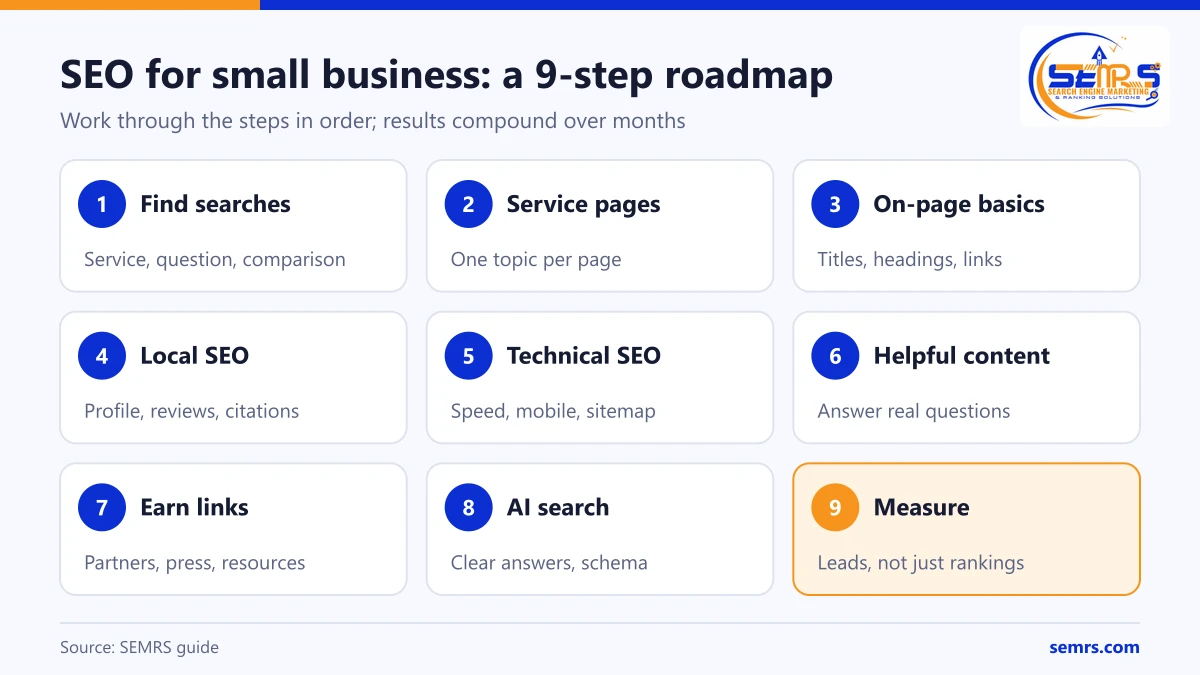
Search engine optimization (SEO) helps your website appear when people search for what you sell. SEO for small business is one of the few marketing channels that keeps bringing customers without paying for every click. This guide covers the steps that matter most, in a sensible order, so you can do the basics yourself or know what to expect from an agency.
On this page
- Key takeaways
- How SEO works in one paragraph
- Step 1: Find the searches your customers make
- Step 2: Give each main service its own page
- Step 3: On-page SEO basics
- Step 4: Local SEO
- Step 5: Technical SEO
- Step 6: Create helpful content
- Step 7: Earn links and mentions
- Step 8: Prepare for AI search
- Step 9: Measure what matters
- How long does SEO for small business take?
- Frequently asked questions
Key takeaways
- Start with the searches your customers make and give each main service its own page.
- Local SEO and technical basics often bring the fastest results for small businesses.
- Judge SEO by leads over months; results compound once pages rank.
How SEO works in one paragraph
Google wants to show the most helpful, trustworthy result for every search. It finds pages by crawling links, understands them through their text and structure, and ranks them using hundreds of signals, including relevance to the search, quality and expertise of the content, how well the page works for visitors and how many trusted sites refer to it. SEO is the work of making your pages the best answer and making sure Google can understand that. Google explains the basics in its own SEO Starter Guide.
Step 1: Find the searches your customers make
Start with the services you sell and the words customers use, not internal jargon. Use Google Keyword Planner, Search Console and our free keyword ideas generator to find:
- Service keywords: “emergency plumber Denver”, “bookkeeping for contractors”.
- Question keywords: “how much does a roof replacement cost”, “do I need a business license for…”.
- Comparison keywords: “Invisalign vs braces”, “LLC vs sole proprietor”.
Choose keywords where you can genuinely be the best answer, and prefer specific long-tail searches when you are starting out.
Step 2: Give each main service its own page
One page should target one topic. A strong service page explains who it is for, the problem it solves, how the service works, prices or price factors, proof such as reviews or case studies, frequently asked questions and a clear call to action.
Step 3: On-page SEO basics
- Title tag: include the main keyword and your brand, around 50–60 characters.
- Meta description: a clear summary that earns the click, around 150 characters.
- One H1 that matches the topic, then H2 and H3 headings for sections.
- Descriptive URLs such as /bookkeeping-for-contractors/.
- Internal links between related pages, using descriptive anchor text.
- Images with descriptive file names and alt text.
Our free SERP snippet preview and meta description checker help you get titles and descriptions right.
Step 4: Local SEO
If you serve a city or region, local SEO often brings the fastest results. Optimize your Google Business Profile, earn reviews, keep your name, address and phone consistent across directories and create genuine location pages for areas you serve.
Step 5: Technical SEO
- Speed and Core Web Vitals: compress images, use good hosting and avoid heavy plugins.
- Mobile-friendly design: most local searches happen on phones.
- HTTPS on every page.
- XML sitemap submitted in Google Search Console.
- No broken links or duplicate pages; use redirects when URLs change.
- Structured data such as LocalBusiness, Service and FAQ markup.
Step 6: Create helpful content
Answer the questions customers ask before they buy. Write from real experience, include examples and photos from your own work, and keep content accurate and up to date. One genuinely useful article a week beats ten thin ones.
Step 7: Earn links and mentions
Links from trusted, relevant sites still matter. Good sources include local business associations, suppliers and partners, local news, sponsorships, industry directories and useful resources others want to cite. Avoid buying links; it breaks Google’s spam policies.
Step 8: Prepare for AI search
Google AI Overviews and AI assistants such as ChatGPT summarize answers from the web. Pages that answer questions clearly, show expertise, use structured data and are cited by other sites have a better chance of being referenced. This is often called generative engine optimization (GEO), and it builds on the same foundations as good SEO.
Step 9: Measure what matters
Track impressions, clicks and positions in Google Search Console, visits and conversions in Google Analytics, and calls and form leads by source. Judge SEO by leads and sales over months, not daily rankings.
How long does SEO for small business take?
Local improvements can appear within a few months. Ranking for competitive terms usually takes six to twelve months of steady work. The results compound: pages that rank keep bringing visitors without a click price.
Frequently asked questions
Can I do SEO for my small business myself?
Yes, the basics in this guide are achievable for most owners. Many businesses do local SEO and content in-house and hire help for technical work, strategy or scaling.
How much does small business SEO cost?
Surveys of SEO providers show the most common monthly retainer band is roughly $500 to $1,000, with agencies averaging around $3,200. See our full SEO cost guide.
What is the most important SEO factor?
Relevance and quality: having the best page for what someone searched. Technical health and authority help that page get found and trusted.
Is SEO better than paid ads?
They complement each other. Ads bring traffic immediately at a cost per click; SEO builds a lasting source of traffic. Most businesses benefit from both.
Can SEMRS do SEO for my business?
Yes. SEMRS provides SEO and GEO services for small and growing businesses, with written plans, human-approved work and reports from your own Google data. Get a free quote.