
There is no fixed Google Ads cost or price list. You set a budget, Google runs an auction for every search, and you pay when someone clicks. In 2025 the WordStream by LocaliQ benchmarks put the average cost per click (CPC) across industries at about $5.26 and the average cost per lead at about $70.11, with legal services the most expensive at about $8.58 per click and $131.63 per lead. Your own costs depend on your industry, location, keywords and how well your ads and landing pages are built.
On this page
Key takeaways
- The 2025 benchmarks put the average cost per click near $5.26 and the average cost per lead near $70.11.
- Legal is the most expensive category at about $8.58 per click and $131.63 per lead.
- Set your budget backwards from the value of a customer, then cut waste with negative keywords.
How Google Ads pricing works
Each time someone searches, Google decides which ads to show and in what order. Two things matter most:
- Your bid: the most you are willing to pay for a click (or the target you give automated bidding).
- Quality: Google’s estimate of how relevant and useful your ad and landing page are, reflected in Quality Score.
Higher quality can win better positions at a lower price. You never pay more than your maximum bid, and you only pay for clicks, not impressions, on standard search campaigns.
Average Google Ads costs by industry
| Industry | What to expect |
|---|---|
| Attorneys and legal services | Highest average CPC (about $8.58) and cost per lead (about $131.63) in the 2025 benchmarks |
| Finance and insurance | Among the most expensive; individual insurance and loan keywords can cost far more than the average |
| Home services | Above average, especially emergency services |
| All industries | Average CPC about $5.26, average cost per lead about $70.11 |
Benchmarks are blended averages from thousands of campaigns. Competitive keywords in big cities can cost several times the average, while long-tail local keywords can cost much less. Keyword Planner shows bid ranges for your own keywords and location.
What drives your Google Ads cost
- Keyword competition: more advertisers bidding means higher prices.
- Location: big metros usually cost more than small towns.
- Match types: broad match reaches more searches, including irrelevant ones; exact and phrase match give more control.
- Ad and landing page quality: relevant ads and fast, matching pages lower costs.
- Schedule and devices: limiting ads to hours you can answer the phone avoids paying for leads you cannot handle.
- Conversion tracking: without it, automated bidding cannot learn which clicks matter.
How to set a Google Ads budget
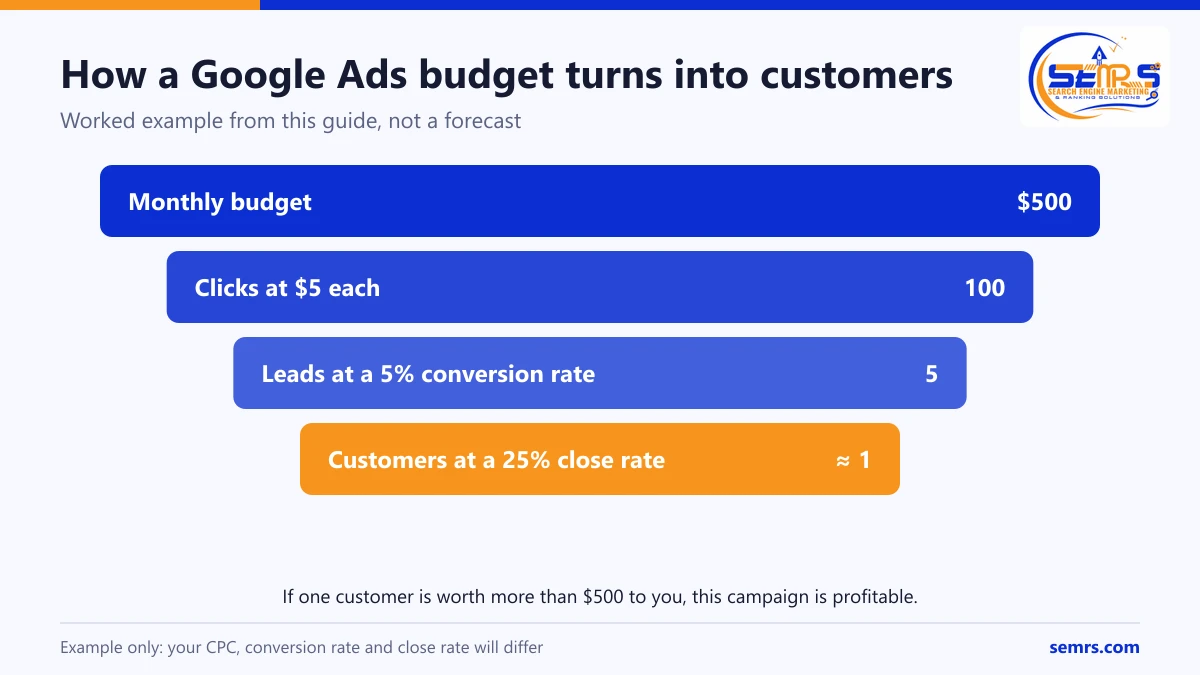
- Work backwards from a customer. Estimate your conversion rate (for example 5% of clicks become leads) and close rate (for example 25% of leads become customers). At a $5 CPC, 100 clicks cost $500, bring about 5 leads and about 1 customer.
- Check that the customer is worth it. If a customer is worth $2,000, that example is profitable. If a customer is worth $200, you need cheaper clicks, better conversion or a different channel.
- Give campaigns enough data. A budget that buys only a handful of clicks a day makes learning slow. Fewer, tightly themed keywords with a sensible daily budget work better than many keywords spread thin.
- Review weekly for the first month. Add negative keywords, pause poor performers and move budget to what converts.
Ways to lower your cost per lead
- Use exact and phrase match for your most valuable services.
- Build a negative keyword list (“free”, “jobs”, “DIY”, “course”, competitor names you do not want).
- Send each ad group to a landing page that matches the search.
- Add call, location and sitelink assets to improve visibility.
- Track calls and forms as conversions, then use smart bidding only once you have conversion data.
- Consider Local Services Ads, which charge per lead in eligible categories.
Google Ads management costs
Besides ad spend, many businesses pay someone to manage campaigns. Agencies usually charge a flat monthly fee, a percentage of ad spend or a mix. Compare what is included: account structure, ad writing, landing page advice, conversion tracking and reporting. SEMRS keeps the management fee separate from your ad spend; see our paid ads service.
Google Ads vs SEO
Ads bring traffic the day they go live but stop when you stop paying. SEO takes months to build but has no cost per click. Most growing businesses run both. Our guide to SEO costs explains the other side.
Frequently asked questions
How much does Google Ads cost per month for a small business?
There is no minimum. Many small businesses start with a few hundred to a few thousand dollars a month. The right amount is the budget that buys enough clicks for your campaigns to learn while staying profitable per customer.
How much does one click on Google Ads cost?
It varies by keyword and location. The 2025 benchmarks put the cross-industry average around $5, with legal services near $9. Use Keyword Planner to see bid ranges for your keywords.
Do I pay if someone sees my ad but does not click?
Not on standard search campaigns, which charge per click. Some display and video campaigns can charge per thousand impressions instead.
Why are my Google Ads so expensive?
Common causes are broad keywords, missing negative keywords, landing pages that do not match the ad and bidding without conversion data. An account review usually finds quick savings.
Can SEMRS manage my Google Ads?
Yes. SEMRS plans and manages Google Ads with a separate, transparent fee and a human approval step before any budget change. Get a free quote.
Sources: Search Engine Land, Google Ads costs keep rising in 2025.