Insurance is a crowded, expensive market to advertise in, and buying leads gets costly fast. The agencies that grow steadily build their own lead sources: a strong local presence, content that answers coverage questions and a referral system that runs every month. Here are twelve insurance agency marketing ideas for agents, ordered from the quickest wins to the long-term assets.
On this page
- Key takeaways
- Insurance agency marketing quick wins (first 30 days)
- 1. Complete your Google Business Profile
- 2. Ask every happy client for a review
- 3. Fix your website’s quote path
- 4. Track calls and forms as conversions
- Paid channels (month 2)
- 5. Google Ads with tight local targeting
- 6. Test Local Services Ads where available
- 7. Use social ads for life events
- Lead generation you own (months 2–3)
- 8. Write content that answers coverage questions
- 9. Build niche landing pages
- 10. Create a referral partner network
- Retention and cross-selling (ongoing)
- 11. Email and text for renewals and reviews
- 12. Annual coverage reviews
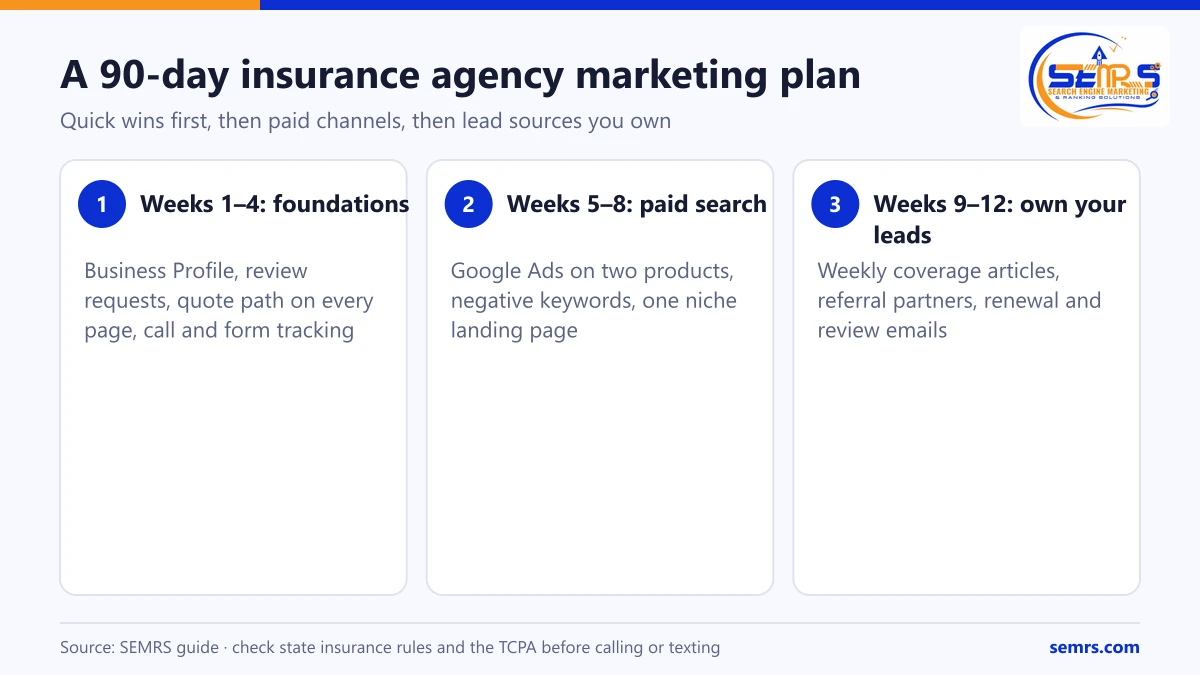
- A simple 90-day plan
- Frequently asked questions
Key takeaways
- Start with free wins: a complete Google Business Profile, steady reviews and a fast quote path.
- Use Google Ads and Local Services Ads with tight local targeting, then build leads you own with content and referrals.
- Get written consent before marketing calls or texts and follow state insurance advertising rules.
This is general marketing guidance. Insurance advertising and telemarketing are regulated by state insurance departments and federal rules such as the TCPA. Check carrier agreements and state rules before you launch a campaign.
Insurance agency marketing quick wins (first 30 days)
1. Complete your Google Business Profile
When someone searches “insurance agency near me” or “auto insurance [city]”, the map results appear first. A complete Google Business Profile is the fastest free way to show up there. Choose the most accurate primary category (for example “Insurance agency” or “Auto insurance agency”), list every line you write, add office photos and keep hours current.
2. Ask every happy client for a review
Reviews influence both rankings and trust. Ask at natural moments: after a smooth claim, a renewal with savings or a quick answer to a question. Send a direct link; our free Google review link generator creates one in seconds. Never offer gifts or discounts in exchange for reviews, which breaks Google’s review policy.
3. Fix your website’s quote path
Visitors want to start a quote in under a minute. Put a short form or a booking link above the fold on every product page, ask only for what you need to call back, and say how fast you respond.
4. Track calls and forms as conversions
Most insurance leads still arrive by phone. Use call tracking numbers per channel and set up conversion tracking in Google Analytics and Google Ads so you know which campaigns create policies, not just clicks.
Paid channels (month 2)
5. Google Ads with tight local targeting
Insurance keywords are among the most expensive on Google, so precision matters more than reach. Target the ZIP codes you can serve, use exact and phrase match for product terms (“home insurance quote Tampa”), add negatives such as “jobs”, “license”, “salary” and “free”, and schedule ads for hours someone can answer the phone. Read our breakdown of Google Ads costs to set a realistic budget.
6. Test Local Services Ads where available
Google Local Services Ads charge per lead rather than per click and appear above regular ads with a badge. Availability depends on your category and state. Our guide to Local Services Ads vs Google Ads explains how they compare.
7. Use social ads for life events
People shop for insurance around life events: a new home, a new car, a wedding, a baby, a new business. Meta and other platforms limit targeting for insurance, credit and similar categories, so build ads around helpful content (“First-home insurance checklist”) rather than narrow demographic targeting, and follow each platform’s special ad category rules.
Lead generation you own (months 2–3)
8. Write content that answers coverage questions
Prospects search questions before they search agents: “Does homeowners insurance cover water damage?”, “How much umbrella insurance do I need?”, “What insurance does a small business need?”. Answer one question a week in plain language, explain what changes the answer and invite readers to a review call. Over time these articles bring steady organic leads at no cost per click.
9. Build niche landing pages
Generic pages compete with national carriers. Niche pages compete with almost no one. Examples: insurance for rideshare drivers, contractor general liability in your state, coverage for short-term rental hosts. Each page should explain the risks, the policy types and the documents a client needs.
10. Create a referral partner network
Mortgage brokers, real estate agents, auto dealers, CPAs and business attorneys meet your future clients before you do. Offer partners a simple way to refer (a short link or form), keep them updated on what happened, and follow your state’s rules on referral payments.
Retention and cross-selling (ongoing)
11. Email and text for renewals and reviews
A monthly email with one seasonal tip (hurricane prep, winter driving, year-end business coverage) keeps you top of mind and produces cross-sell questions. For texts and automated calls, collect clear written consent first and honor opt-outs immediately; the TCPA and state laws carry heavy penalties (see the FCC guide to unwanted calls and texts).
12. Annual coverage reviews
The cheapest new policy is the one an existing client already needs. Schedule annual reviews, ask about life changes and offer bundles where they genuinely save money.
A simple 90-day plan
| Weeks | Focus | Result to measure |
|---|---|---|
| 1–4 | Business Profile, reviews, quote path, tracking | Calls and form leads per week |
| 5–8 | Google Ads on two products, one niche landing page | Cost per qualified lead |
| 9–12 | Weekly coverage articles, referral partners, renewal emails | Organic leads and referrals |
Frequently asked questions
What is the best insurance agency marketing strategy for leads?
Combine a strong local presence (Business Profile and reviews), a fast quote path on your website and one paid channel you can measure. Bought leads can fill gaps, but leads you generate yourself are usually cheaper per policy over time.
Is buying insurance leads worth it?
It can be, if leads are exclusive, recently generated and consented for contact, and if you call within minutes. Compare cost per bound policy, not cost per lead, before scaling any vendor.
How much should an insurance agency spend on marketing?
Set a monthly budget you can sustain for six months and judge each channel by cost per bound policy and client lifetime value. Paid search budgets need enough clicks per month to learn, so start with fewer keywords rather than a thin budget across many.
Does SEO work for insurance agents?
Yes, especially local SEO and niche content. National carriers dominate broad terms, but local and niche searches (“contractor insurance in Ohio”) are winnable for independent agencies.
Can SEMRS run marketing for my agency?
Yes. SEMRS handles SEO, Google Ads and lead generation and content, with a person reviewing every piece before it goes live. Request a free quote.