
Financial advisor marketing works best when it does three things at once: it makes clear who you serve, it shows up where those people search for help, and it stays inside the advertising rules that apply to your firm. This guide walks through each part, from choosing a niche to running Google Ads, with the compliance points to check before anything goes live.
On this page
- Key takeaways
- Why financial advisor marketing is different
- Step 1: Pick a niche you can describe in one sentence
- Step 2: Build a website that answers questions, not just a brochure
- Step 3: SEO for financial advisors
- Local SEO
- Content that answers niche questions
- Technical basics
- Step 4: Google Ads and paid lead generation
- Step 5: Referrals, partnerships and LinkedIn
- Step 6: Email that keeps you top of mind
- Compliance checklist before you publish
- Measure what matters
- Frequently asked questions
Key takeaways
- Pick a niche you can describe in one sentence; it makes SEO, ads and referrals easier.
- Answer-first niche pages, local SEO and weekly content bring prospects who are already searching.
- Every ad and page needs compliance review under the SEC Marketing Rule or FINRA Rule 2210.
This article is general marketing guidance, not legal or compliance advice. Ask your compliance officer or counsel to review any advertisement before you publish it.
Why financial advisor marketing is different
Most small businesses can say almost anything that is true about their service. Advisors cannot. Registered investment advisers (RIAs) follow the SEC Marketing Rule (Rule 206(4)-1 under the Investment Advisers Act), and broker-dealer representatives follow FINRA Rule 2210 on communications with the public. Both rules care about the same ideas: claims must be fair and balanced, performance must be presented with the required context, and testimonials or endorsements come with disclosure duties.
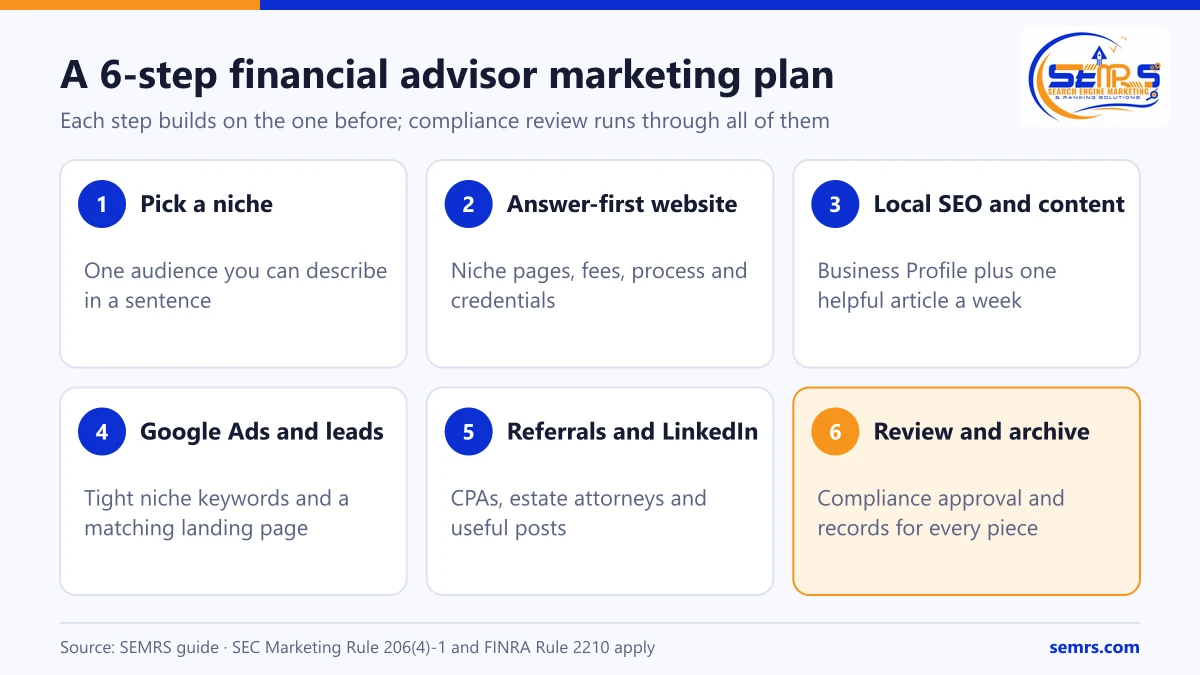
That changes how marketing is planned. Every page, ad and social post needs a review step, records must be kept, and some popular tactics, such as quoting cherry-picked returns, are off the table. The upside is that competitors face the same limits, so the advisors who win are the ones with the clearest message and the most useful content.
Step 1: Pick a niche you can describe in one sentence
“Wealth management for families” is too broad to rank on Google or to remember. A niche makes every later step easier, because you can write content for one audience’s real questions. Strong niches usually combine a profession or life stage with a problem:
- Retirement income planning for teachers with a pension
- Equity compensation planning for tech employees with RSUs and stock options
- Financial planning for physicians in their first ten years of practice
- Business succession and exit planning for owners of family companies
- Planning for divorced women rebuilding their finances
Write your niche sentence at the top of your website, your Google Business Profile and your LinkedIn profile. Consistency helps both people and search engines understand what you do.
Step 2: Build a website that answers questions, not just a brochure
Many advisor websites list services and a team photo, then stop. Prospects searching late at night want answers first. Plan these pages before anything else:
- A niche landing page for each audience you serve, written in their words.
- A clear “How we work” page that explains your process, minimums if you have them, and how you are paid (fee-only, fee-based or commission). Transparency about fees builds trust.
- Service pages for retirement planning, tax-aware investing, estate coordination or whatever you actually offer.
- An about page with real credentials (CFP®, CFA, ChFC), registration status and links to your Form ADV or BrokerCheck record.
- A contact page with a short form and a booking link.
Speed and mobile layout matter: most first visits happen on a phone. If you need a site rebuilt, our web design service builds fast, accessible WordPress sites that are easy to keep compliant.
Step 3: SEO for financial advisors
Search engine optimization brings prospects who are already looking. Keyword Planner data shows steady US demand for terms such as “financial advisor marketing”, “marketing for RIAs” and “lead generation for financial advisors”, and much larger demand for consumer questions your clients ask every day. Focus on three layers.
Local SEO
Most clients still want an advisor in their region. Claim and complete your Google Business Profile, choose the right primary category (for example “Financial planner”), add your services, and ask happy clients for reviews where your rules allow it. Check your compliance policy first: under the SEC Marketing Rule, client reviews on third-party sites can count as testimonials, and FINRA has its own guidance on third-party sites.
Content that answers niche questions
Write one helpful article a week that answers a question your niche asks. Examples: “Should a teacher take a lump sum or the pension?”, “What happens to unvested RSUs if I leave my job?”, “How do I pay myself from an S corporation in retirement?”. Explain the trade-offs plainly and avoid promises about outcomes.
Technical basics
Make sure every page has a unique title and description, loads quickly, uses headings that match the questions people search, and links to related pages. Our free SERP snippet preview shows how a page will look in Google before you publish.
Step 4: Google Ads and paid lead generation
Paid search puts you in front of people searching right now. Financial terms are among the most expensive on Google, so a small budget needs tight targeting:
- Use exact and phrase match keywords tied to your niche, such as “retirement planner for teachers”.
- Add negative keywords for job seekers (“financial advisor jobs”, “salary”, “course”).
- Send traffic to a niche landing page, not your home page.
- Track calls and form submissions as conversions so you can see the cost per lead.
Google also runs Local Services Ads with a “Google Screened” badge for some professional services. Availability depends on your category and location; read our comparison of Local Services Ads and Google Ads before you choose.
Bought lead lists and shared lead platforms can work, but quality varies widely. Ask how leads are generated, whether they are exclusive, and what consent the prospect gave to be contacted, especially before calling or texting.
Step 5: Referrals, partnerships and LinkedIn
Referrals remain the strongest channel for most advisors. Make them easier:
- Build relationships with CPAs, estate attorneys and HR leaders who serve your niche.
- Create a short, compliant “what to expect” guide that a referral partner can share.
- Post useful, non-promotional insights on LinkedIn two or three times a week, and keep copies as your firm requires.
- Host a small educational webinar each quarter on one niche topic.
Step 6: Email that keeps you top of mind
Most prospects are not ready the first time they find you. A monthly email with one useful idea, one planning reminder and one invitation to book a call keeps the relationship warm. Use a reputable email platform or CRM with archiving that fits your recordkeeping duties.
Compliance checklist before you publish
- Is every claim factual, balanced and supportable?
- Do performance figures include the required periods, net-of-fee presentation and disclosures?
- Do testimonials, endorsements or third-party ratings carry the disclosures your rule requires?
- Has the piece been reviewed and approved, and is a copy archived?
- Does the website show your registration status and link to Form ADV or BrokerCheck?
Measure what matters
Track four numbers each month: qualified consultations booked, cost per consultation, consultation-to-client rate and new assets or revenue per channel. Our free SEO ROI calculator helps you compare channels on the same basis.
Frequently asked questions
How much should a financial advisor spend on marketing?
There is no single right number. Many firms set a budget as a share of revenue and then judge each channel by its cost per new client. Start with a budget you can sustain for at least six months, because SEO and referrals take time to compound.
Can financial advisors use client testimonials?
Since the SEC Marketing Rule took effect, registered investment advisers may use testimonials and endorsements if they meet the rule’s disclosure, oversight and, for paid promoters, written-agreement conditions. Broker-dealers follow FINRA rules. Confirm your firm’s policy before using any.
What is the best marketing channel for financial advisors?
For most independent advisors, a clear niche plus local SEO and referral partnerships produce the best long-term results, while Google Ads can add leads faster at a higher cost. Test one paid channel at a time and measure cost per consultation.
How long does SEO take for a financial advisor website?
Local results can improve within a few months once your Business Profile and site basics are fixed. Ranking for competitive topics usually takes six to twelve months of steady, helpful content.
Should I hire a marketing agency that specializes in financial advisors?
An agency that understands compliance review, recordkeeping and your niche saves time. Ask for examples, how they handle approvals and how they report results. SEMRS offers SEO and paid ads with a human approval step on every deliverable.
Want a marketing plan built around your niche and your compliance process? Get a free quote from SEMRS.