
General liability insurance pays for claims that your business caused injury to someone else or damaged their property, plus your legal defense. Clients and landlords ask for it more than any other cover. The U.S. Small Business Administration says any business may need it. This guide shows what the policy covers, what it leaves out, what it costs and how to buy one.
On this page
- Key takeaways
- What general liability insurance covers
- What general liability does not cover
- Who needs general liability cover?
- How much does general liability insurance cost?
- What affects your premium
- Business owner’s policy (BOP) vs general liability
- Occurrence vs claims-made policies
- How to buy general liability insurance: seven steps
- Common mistakes to avoid
- Frequently asked questions
Key takeaways
- General liability covers third-party bodily injury, property damage, and personal and advertising injury, plus legal defense costs.
- It does not cover your own employees, your own property, professional mistakes or vehicles; those need other policies.
- Small businesses with Insureon paid a median of about $45 a month in 2026, but your price depends on your industry, location and limits.
This article is general information, not insurance or legal advice. Coverage depends on the exact policy wording and your state. Speak to a licensed insurance agent or broker before you buy or change a policy.
What general liability insurance covers
A standard commercial general liability (CGL) policy usually covers four things:
- Bodily injury to other people, such as a customer who slips in your shop.
- Property damage you cause to someone else’s property, such as a contractor who damages a client’s floor.
- Personal and advertising injury, such as claims of libel, slander or copying someone’s advertising.
- Legal defense costs for a covered claim, even one that turns out to be false.
The ad part matters for any business that markets itself. Say someone claims your ad used their slogan, photo or brand name. That claim may fall under this cover, based on your policy. It is still far better to use only content you own or have paid to use.
What general liability does not cover
| Situation | Policy usually needed |
|---|---|
| An employee is hurt at work | Workers’ compensation |
| A client says your advice or service caused a financial loss | Professional liability (errors and omissions) |
| Fire or theft damages your own equipment or premises | Commercial property, often in a business owner’s policy |
| An accident in a company vehicle | Commercial auto |
| A data breach exposes customer information | Cyber liability |
| A product you make or sell causes harm | Product liability (sometimes included; check your policy) |
Policies also leave out harm you cause on purpose and fines in your contracts. Many limit cover for some trades. Read the list of what is not covered, or ask your agent to walk you through it.
Who needs general liability cover?
The SBA’s business insurance guide lists general liability as coverage any business may need. You are especially likely to need it if:
- Customers or suppliers visit your premises.
- You work at clients’ homes or sites, as contractors, cleaners and installers do.
- A landlord, client or contract asks for a certificate of insurance.
- You advertise, run a website or post on social media.
Businesses with employees also need workers’ compensation in most states, and the rules are set by each state. General liability does not replace it.
How much does general liability insurance cost?
Insureon reported in March 2026 that its small business customers paid a median of about $45 a month for general liability. In the same data:
- 22% paid less than $30 a month, and 41% paid between $30 and $60.
- Annual premiums ranged from about $265 to $3,030.
- 85% chose limits of $1 million per occurrence and $2 million aggregate.
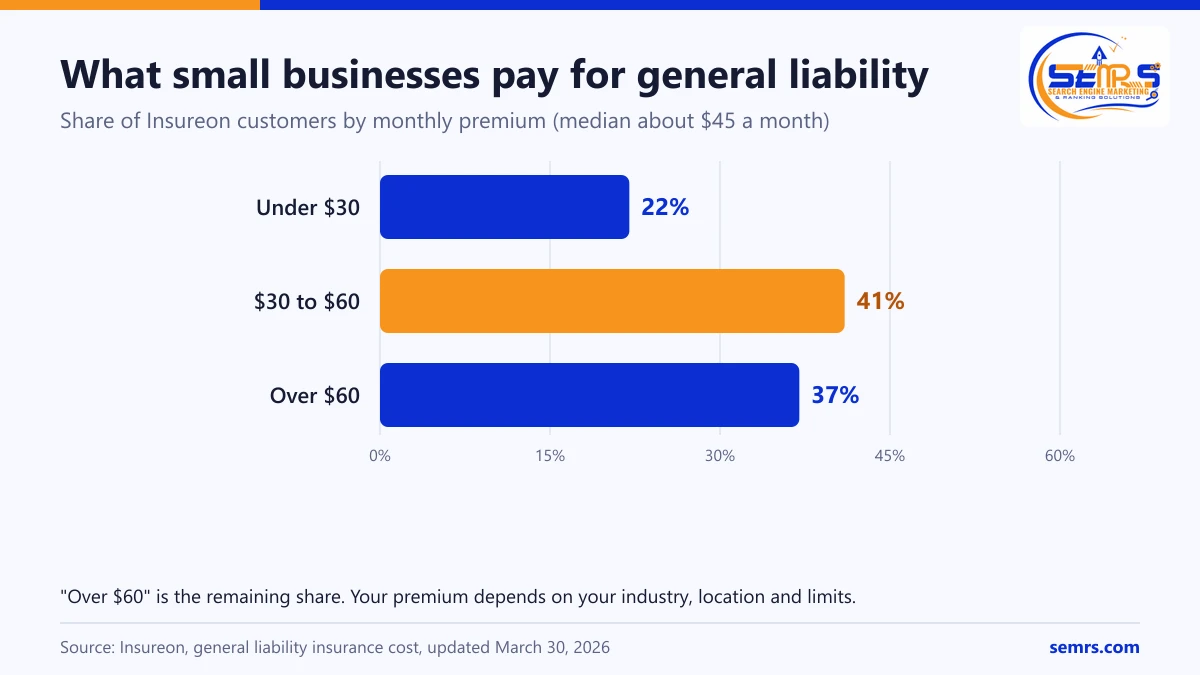
These figures come from one firm’s customers, and many of them are low-risk. Treat them as a guide, not a quote. A roofer will pay far more than a consultant who works from home.
What affects your premium
- Your industry and the work you do.
- Policy limits and deductible.
- Your location and state.
- Number of employees, payroll and annual revenue.
- The size and condition of your premises.
- Years in business and your claims history.
Business owner’s policy (BOP) vs general liability
A business owner’s policy (BOP) bundles general liability with cover for your own building and kit. It often costs less than buying both on their own. The SBA describes it as a package that suits most small business owners. If you own equipment, stock or furniture, ask for a BOP quote alongside a standalone general liability quote.
Occurrence vs claims-made policies
Most policies are written on an occurrence basis. They cover events that happen while the policy is live, even if the claim comes years later. A claims-made policy covers claims made while the policy is live. If you are offered claims-made cover, ask about the start date it looks back to and “tail” cover for when it ends.
How to buy general liability insurance: seven steps
- List your risks. Who visits you, where you work and what could go wrong.
- Check what clients and landlords require. Note the limits and any “additional insured” wording in your contracts.
- Choose limits. $1 million per occurrence and $2 million aggregate is common, but some contracts require more.
- Talk to a licensed agent or broker. Independent agents can compare several insurers for you.
- Compare at least three quotes. Compare limits, deductibles, exclusions and the insurer’s financial strength, not just price.
- Ask about a BOP if you also need property cover.
- Get your certificate of insurance and review the policy every year, or when your work changes.
Common mistakes to avoid
- Buying the cheapest policy without reading the exclusions.
- Assuming general liability covers your employees or professional errors.
- Choosing limits below what your contracts require.
- Forgetting to update the policy when you add services, staff or locations.
- Using photos or content in your marketing that you do not have rights to.
Frequently asked questions
Is general liability insurance required by law?
Usually not by law, but clients, landlords and many contracts require it, and some licenses and permits ask for proof of coverage. Workers’ compensation, not general liability, is the policy most states require for businesses with employees.
How much general liability cover do I need?
Many small businesses choose $1 million per occurrence and $2 million aggregate, which Insureon says 85% of its customers selected. Check your contracts and leases, because some require higher limits.
Does general liability cover my own injuries?
No. It covers injuries to third parties. Your own injuries are usually covered by health insurance, and your employees’ work injuries by workers’ compensation.
What is a certificate of insurance?
A certificate of insurance is a one-page document from your insurer or agent that proves you have coverage and shows your limits. Clients and landlords often ask for one before you start work.
Does SEMRS sell insurance?
No. SEMRS is a digital marketing agency and does not sell or arrange insurance. If you are an insurance agency that wants more leads, read our guide to insurance agency marketing or see our pricing.
Running a small business? Read more in the Business Insurance category or our guide to small business loans for marketing.
Sources: U.S. Small Business Administration, Get business insurance; Insureon, General liability insurance cost (updated March 30, 2026).