
AI marketing tools can draft content, suggest keywords, write ad variations, resize images and summarize reports in minutes. Used well, they free a small team to focus on strategy and customers. Used carelessly, they produce generic content, factual errors and brand risks. This guide groups AI marketing tools by job, explains what to look for and sets out the human checks every business should keep.
On this page
Key takeaways
- AI marketing tools are best at first drafts, variations, research help and report summaries.
- Facts, expertise, regulated topics and publishing decisions still need a person.
- A safe workflow uses AI for drafts and people for fact checks and approval.
What AI marketing tools are good at
- First drafts: outlines, blog drafts, product descriptions, email sequences and social captions.
- Variations: many versions of ad headlines or subject lines to test.
- Research help: summarizing competitor pages, grouping keywords and finding question ideas.
- Repurposing: turning one article into a newsletter, social posts and a video script.
- Design and images: resizing, background removal and on-brand templates.
- Analysis: summarizing Search Console, Analytics and ad reports in plain language.
Where AI still needs a person
- Facts and numbers: AI tools can state wrong figures confidently. Every statistic needs a source.
- Expertise and experience: Google’s guidance rewards content that shows real experience. Add your own examples, results and opinions.
- Regulated topics: finance, legal, health and insurance content needs expert review.
- Brand voice: AI output tends to sound the same as everyone else’s until you edit it.
- Publishing decisions: a person should approve anything that goes public.
AI marketing tools by category
| Job | Examples of tools | What to check |
|---|---|---|
| Writing and ideas | ChatGPT, Claude, Gemini | Data privacy settings, team plans, accuracy on your topic |
| SEO research | Keyword tools with AI features, Google Keyword Planner, Search Console | Real search data behind suggestions |
| Ads | Google Ads automatically created assets, Performance Max | Brand controls, ability to review assets |
| Design | Canva, Adobe Express | Brand kits, licensing of generated images |
| Email and CRM | Email platforms and CRMs with AI writing and send-time features | Deliverability, list rules, consent tracking |
| Analytics | GA4 insights, AI summaries in reporting tools | Whether summaries match the raw data |
Tool names change fast; judge any tool by the checks in the right-hand column rather than by its marketing.
How to choose an AI marketing tool
- Start with the bottleneck. If writing takes most of your week, start with a writing assistant. If reporting does, start with analytics.
- Check data privacy. Use business plans that do not train on your data when you handle client or customer information.
- Test on real work. Give each tool the same three tasks and compare the output after editing.
- Count editing time. A tool that saves drafting time but needs heavy fixing may not save anything.
- Integrations matter. Tools that connect to your CMS, CRM or ad accounts save copy-and-paste time.
Does Google penalize AI content?
Google’s position is that it rewards helpful content regardless of how it is produced, and that using automation to mass-produce pages mainly to manipulate rankings breaks its spam policies on scaled content abuse. In practice: AI-assisted content is fine when a knowledgeable person shapes it, checks it and adds real value; hundreds of thin AI pages are a risk.
A safe AI content workflow
- A person defines the brief: audience, goal, keyword and the points that must be included.
- AI produces an outline and a draft.
- A subject expert checks facts, adds examples and removes generic filler.
- An editor checks voice, links, claims and compliance.
- A person approves publication and records sources.
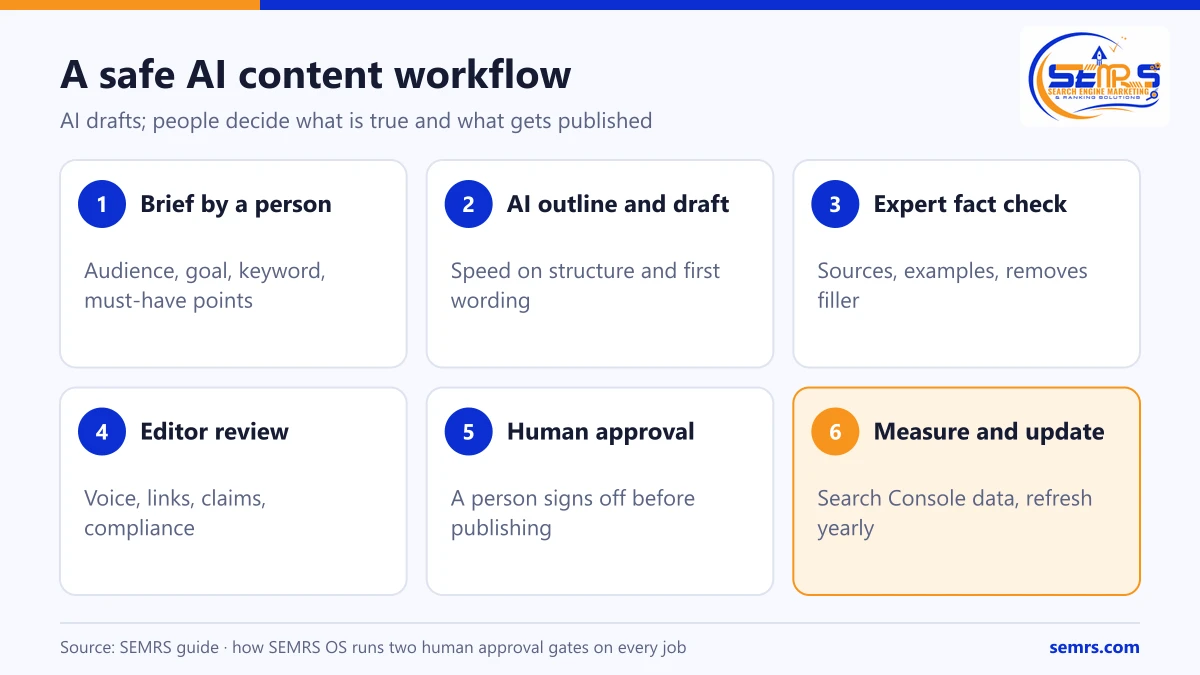
This is how SEMRS OS, our AI marketing operating system, works: specialist AI agents for research, SEO, content and review, with two human approval gates on every job. Learn more on the SEMRS OS page.
Frequently asked questions
What is the best AI marketing tool for a small business?
The best tool is the one that removes your biggest bottleneck and fits your data rules. Many businesses start with a general writing assistant and the AI features already inside their email platform, CRM and ad accounts.
Can AI replace a marketing agency?
AI speeds up tasks but does not replace strategy, judgement, accountability or expertise in regulated industries. Many businesses use AI tools in-house and an agency for strategy, review and channels that need specialists.
Is AI-generated content bad for SEO?
Not by itself. Content that is accurate, helpful and shows real expertise can rank whether or not AI helped. Mass-produced, low-value pages can be treated as spam.
Are AI marketing tools expensive?
Many have free tiers and low monthly plans for individuals. Team plans with privacy controls cost more. Compare cost against hours saved after editing.
How does SEMRS use AI?
SEMRS OS uses AI agents for research, drafting and review, and every deliverable passes two human approval gates before it reaches a client. Get a free quote for content or SEO.